
The Southeast Asian SaaS Scaling Reality
Evaluating enterprise software startups across Southeast Asia begins with a hard geographical constraint. Founders face 11 distinct regulatory jurisdictions requiring separate data localization compliance audits taking between 45 and 65 days per market entry. This fragmentation creates an immediate operational bottleneck for companies attempting rapid regional expansion.
Western software models assume a unified regulatory environment and standardized enterprise procurement. Attempting a direct transfer of these models to Asian enterprise markets consistently stalls. Drawing on deployment timelines established during the PT M Cash Integrasi Tbk (MCAS) infrastructure rollout, the investment committee established this specialized due diligence framework. Applying standard Silicon Valley growth metrics failed to account for the severe compliance overhead required to operate across the region's fragmented legal landscape.
A specialized evaluation approach looks beyond user acquisition velocity. It examines a startup's capacity to absorb legal friction, manage localized server deployments, and navigate complex government data sovereignty mandates. Startups that build compliance timelines into their core growth projections demonstrate the operational maturity required for this market.
Measuring Retention Across Diverse Enterprise Cultures
Enterprise software adoption maturity varies drastically between neighboring countries. A procurement department in Singapore expects seamless self-serve onboarding and comprehensive API documentation. A manufacturing conglomerate in Indonesia relies heavily on relationship-driven vendor management and intensive hands-on training. Vietnam presents a rapidly digitizing workforce that demands mobile-first interfaces and immediate localized support.
Localized customer success infrastructure outweighs automated onboarding in this region. High-touch implementation ensures that legacy employees actually adopt the new software. Automated email sequences and tooltip tours rarely overcome the ingrained workflow habits of traditional Southeast Asian enterprises.
Evaluating User Friction Through ShadowingTo assess true product-market fit, the evaluation team shadows local customer success representatives during deployment rather than relying solely on automated software login logs. This qualitative approach captures the actual user friction experienced on the factory floor or in the back office.
Our venture capital team applies a highly qualitative approach to assessing founder adaptability and local market empathy during the early stages of product-market fit. Observing how a founder responds to a frustrated end-user in a tier-2 city provides deeper insight into long-term retention than any aggregated usage dashboard. Founders who actively modify their deployment strategies based on these localized observations build highly resilient companies.
Unit Economics and Cross-Border Acquisition Costs
Customer Acquisition Cost behaves unpredictably when a startup attempts to cross borders within the region. Marketing channels that yield cheap leads in Manila may produce few qualified enterprise leads in Jakarta. Startups must rebuild their entire go-to-market motion, hire local sales directors, and establish new vendor relationships for every country they enter.
Local currency fluctuations and varying purchasing power heavily impact long-term Lifetime Value. A multi-year contract signed in local currency can lose significant value against the US dollar over its lifespan. Analysts calculate long-term Lifetime Value by pegging historical contract values to a trailing 24-month currency exchange average, normalizing local currency depreciation against the USD to reveal true pricing power. This currency-normalized LTV calculation breaks down when applied to short-term, month-to-month SME subscriptions where rapid churn outpaces foreign exchange impact. For multi-year enterprise agreements, it remains an essential metric for projecting actual cash flow.
Identifying sustainable pricing power requires examining a startup's ability to enforce annual price increases in markets where enterprise clients are highly cost-sensitive. Companies that embed themselves into mission-critical operations—such as payroll processing or inventory routing—can successfully negotiate these increases. Software that serves merely as a productivity enhancement faces immediate budget cuts during regional economic downturns.
Technical Diligence for Regional Integration
Over-engineered platforms frequently lack practical utility for legacy Southeast Asian conglomerates. Silicon Valley startups often build for environments with ubiquitous high-speed internet and modern cloud infrastructure. Regional enterprises operate on heavily customized, decade-old on-premise servers.
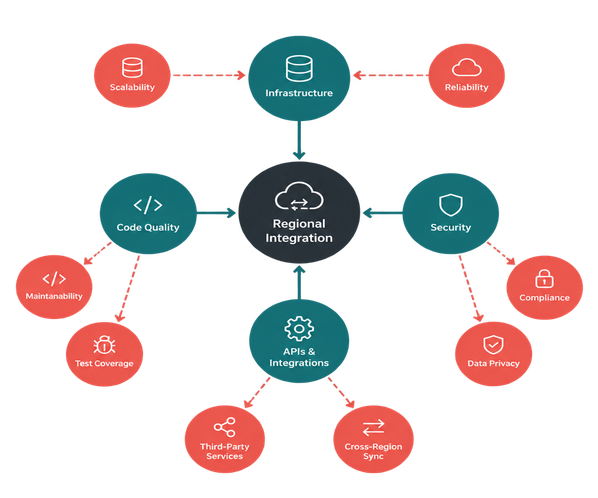
The technical audit process involves testing API payloads directly against the legacy on-premise ERP systems commonly found in regional conglomerates, prioritizing timeout resilience over advanced feature sets. A platform's ability to gracefully handle dropped connections and delayed server responses determines its actual utility in the field. API payload limits restricted to under 50 kilobytes ensure successful transmission across tier-2 city cellular networks.
Mobile-first and low-bandwidth operational capabilities are mandatory for deployments outside major metropolitan hubs. Logistics drivers, warehouse staff, and field sales representatives rely on fluctuating 3G and 4G connections. Software that requires a continuous, high-bandwidth connection will fail during daily operations. Technical diligence must verify offline functionality, local data caching, and background synchronization protocols.
B2B SaaS Regional Diligence Checklist
- Verify data localization compliance timelines for all 11 regional jurisdictions.
- Audit API payload sizes for low-bandwidth environment compatibility.
- Calculate LTV using a trailing 24-month currency exchange average.
- Assess offline functionality and background synchronization protocols.
- Map the integration pathways for legacy on-premise ERP systems.
Prioritizing Go-to-Market Execution Over Code
Investors must prioritize a startup's localized distribution strategy and enterprise relationships over pure technical superiority. The most successful B2B SaaS companies in Southeast Asia win through operational execution and localized trust. During the final term sheet review, the venture team weights the founder's direct relationships with local distributors and system integrators significantly higher than the proprietary nature of the underlying codebase. Capital deployed into strong regional distribution networks yields sustainable enterprise adoption and long-term market dominance.