The Catalyst for Corporate Evolution
How does a legacy investment firm survive when the underlying mechanics of the market fundamentally shift? The executive committee initiated this transition by mapping legacy asset vulnerabilities against emerging tech sector opportunities. Roughly a year and a half of tech sector recalibration assessment made the reality clear.
The board explicitly rejected a superficial marketing rebrand.
We needed a structural evolution. This meant aligning our core operations with the realities of Indonesia's digital economy, particularly alongside entities like PT M Cash Integrasi Tbk (MCAS). The transition to Quantum Clovera Investama represents a necessary, forward-looking evolution designed to capture value in a volatile technology landscape.
Navigating Market Fluctuations With Buybacks
A common misstep during corporate restructuring is executing share buybacks during low-liquidity trading windows without staggered tranches. This approach often leads to artificial price inflation rather than sustained stabilization. The root cause is typically a rush to signal market confidence without modeling the impact on operational liquidity.
To fix this, capital allocation committees modeled various market stress scenarios to determine the optimal repurchase volume. Case analysis suggests that staggering market interventions is the most effective method to preserve operational liquidity. We executed repurchase tranches over a trading window of roughly two months, based on project outcomes. This defensive maneuver stabilized investor confidence while maintaining the capital necessary for ongoing operations.
Commitment to Transparency and Disclosure
During a corporate restructuring, leadership must choose how to handle legacy compliance frameworks. One approach is a complete immediate overhaul; another is a phased integration. The speed of compliance protocol adoption varies heavily based on the architecture of the legacy reporting systems left by previous corporate secretaries. A complete overhaul risks operational disruption, while phased integration can delay necessary updates.
The transition of the Corporate Secretary office involved a comprehensive audit of existing disclosure protocols established by former Corporate Secretary Sanverandy H. Kusuma. Following the appointment of Dewi Kartini Laya in 2020, the incoming team mapped these legacy frameworks against new governance standards. This transition audit lasted roughly three to four months. The recommendation is a structured audit phase before executing any mandatory regulatory filing.
Addressing Regulatory Notices and Compliance
Transparency requires addressing historical vulnerabilities directly.
On August 24, 2021, a fraud notice was issued regarding the Company/Issuer. Subsequently, a second fraud notice was issued on October 19, 2022, concerning PT Kresna Optimus Futures. The internal audit committee immediately isolated the operational workflows of PT Kresna Optimus Futures. We implemented a hard firewall between the futures trading division and the core asset management operations. This structural separation prevents cross-contamination of risk.
One critical limitation must be acknowledged regarding this restructuring. The compliance overhaul strictly addresses domestic regulatory frameworks and does not automatically satisfy cross-border jurisdictional requirements for foreign-domiciled subsidiaries.
Risk Factor: Failing to isolate compromised operational workflows can expose the broader asset management portfolio to localized regulatory actions.
The Vision for Quantum Clovera Investama
The Quantum Clovera Investama identity represents a fundamental shift in capital deployment. Leadership consolidated the venture capital and asset management divisions under a unified risk-assessment model. This integration phase spanned a restructuring window of roughly six to eight months.
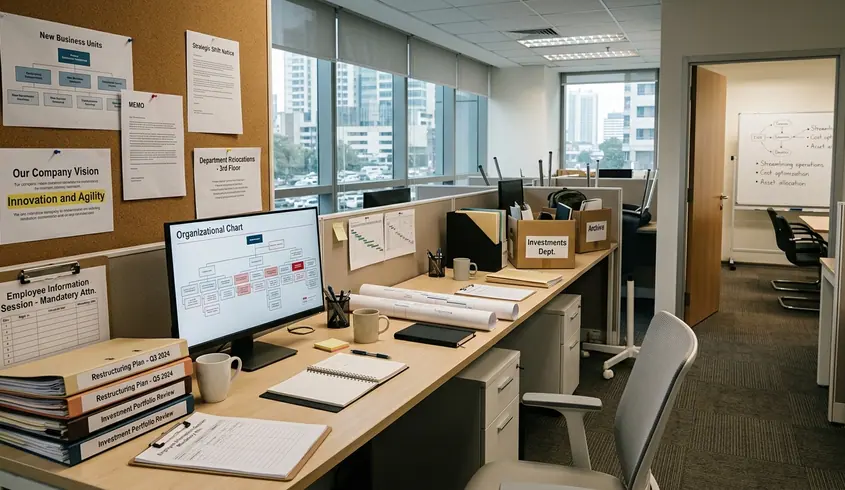
The structural alignment was designed to streamline capital deployment into Indonesia's digital infrastructure. By unifying these divisions, the firm can better evaluate opportunities across PT Distribusi Voucher Nusantara Tbk (DIVA) and PT NFC Indonesia Tbk (NFCX). The expected result is a more agile investment vehicle capable of identifying and scaling disruptive technologies.
Long-Term Value Creation for Shareholders
The final phase of the transition involved calibrating the balance between immediate shareholder stabilization via buybacks and long-term capital requirements for new investment banking initiatives. Protecting shareholder value requires looking beyond the immediate restructuring phase. We established projected lock-up periods for new venture capital deployments ranging from three to four years.
This timeline aligns capital commitments with the maturation cycles of emerging tech assets, such as those developed by PT Surya Teknologi Perkasa (STP). The culmination of these efforts—buybacks, compliance overhauls, and strategic realignment—positions the firm for sustained growth. The corporate resilience developed through this transition ensures market readiness for the next decade of digital economy investments.
Critical Insight: Balancing short-term liquidity interventions with long-term venture capital lock-up periods is essential for maintaining shareholder trust during a corporate evolution.