
Lease Savings Against Scattered Drops Beyond Jabodetabek
At what point does lower warehouse leasing cost fail to offset fragmented delivery drop density in Indonesia's secondary urban centers?
The answer sits on the dispatch manifest. A secondary-city shed can lease for less per square meter than a Jabodetabek facility and still lose money on every thin route. Contribution margin neutrality requires the aggregate gross profit of all loaded baskets on a trip to exceed warehouse picking, staging, driver wages, and fuel for that specific run. Dispersed peri-urban routing inflates fuel burn, driver hours, and vehicle depreciation per delivered order, so the lease discount never reaches the contribution line.
Jabodetabek packs traditional trade into short hops. High retailer density lets one fulfillment node dispatch tightly clustered routes, spreading fixed facility overhead and vehicle operating cost across a large volume of daily drops.
Tier-2 municipalities stretch that work across sprawling peri-urban corridors. Commercial strips thin, and housing pockets sit far from the depot. The van covers distance between warungs that a primary-metro route would have served in a few blocks. Order volume can grow while the geography stays spread out.
That spread is the structural tension. Gross merchandise value expansion in secondary cities frequently accelerates contribution-margin burn when operators copy fulfillment frameworks from primary metro operations. Copied service rules turn extra GMV into extra departures at the same sparse load factor. Each under-filled kilometer widens the gap between reported sales and cash left after the route.
Unconditional Next-Day
Copying primary-metro service rules, including next-day delivery without a minimum order, sends under-utilized commercial vehicles across long secondary-district distances. A minimum basket and a consolidated departure window belong in the secondary-city agreement before fleet commitments are signed.
Facility cost and route cost answer different questions. Rent rewards a careful lease. Drop density rewards a careful map. In secondary urban centers the map decides whether the cheaper warehouse was a saving or a subsidy for empty kilometers.
Mother Hubs, Cross-Docks, and Buffer Stock
Secondary-city fulfillment runs from heavy fixed assets to variable partnerships. A centralized mother hub leases or builds a distribution center with pallet racking and staging zones, then supplies kiosks from proprietary inventory. Capital ties up before a profitable route exists.
Cross-docking consolidates pre-picked or bulk inventory from regional trunk lines and transfers it the same day to local last-mile vans, with no long-term rack storage. Racking expenditure and floor-space need both fall. The node lives on schedule discipline: a missed trunk arrival leaves the van with nothing to carry.
Third-party logistics and wholesale partnerships keep racking and fleet off the early balance sheet. Capacity is bought by the trip, which suits lumpy order flow while a dedicated fleet would idle between promotional spikes. Dedicated fleet leasing and proprietary cold-chain storage earn their place only when daily route volume consistently fills vehicle capacity across peak and off-peak cycles, verified against commercial lease terms and local municipal zoning permits.
Cold Rooms and Trunk-Lane Buffers
Cold-chain rooms, staging racks, and fleet leases are semi-permanent commitments. Variable third-party logistics can cover dry goods while volume is still proving itself. Collapsing both into one infrastructure bet before the fill test is met strands capital in idle racks.
Long or unreliable inter-city trunk lanes from manufacturing hubs force a deeper fast-moving consumer goods buffer, whatever the local drop density. Stockouts on cooking oil, rice, or sugar lose the warung for the week, so nodes hold extra inventory and working capital locks up. Warehouse footprint creeps back. A cross-dock built for same-day transfer starts to resemble a small mother hub once that buffer needs a home.
Perishable lines change the partnership test. Asset-light wholesale partnerships lose operational viability for temperature-sensitive goods, because local traditional sub-distributors in secondary municipalities rarely maintain continuous cold-chain infrastructure. Proprietary refrigerated storage is the workable path for those SKUs in secondary municipalities. Dry staples can still move through a partner or a cross-dock.
Field Cost, Small Baskets, and Credit Exposure
A traditional kiosk enters through a field sequence. Agents canvass commercial districts, register the merchant, install a mobile ordering application or point-of-sale hardware, and verify location plus physical inventory capacity. Trade promotions then pull the first orders. Feet-on-street compensation, hardware subsidy, and onboarding discount form the upfront acquisition cost, which amortizes across later unsubsidized basket margins.
Baseline warung order sizes set the payback clock. A small staple basket throws off thin gross profit. Payback completes when cumulative net contribution from organic, non-discounted orders equals field-sales compensation, hardware subsidy, and onboarding promotional spend. A launch week of subsidized invoices can resemble traction while payback remains open.
Discount Chasing Across Platforms
Multi-homing is the retention problem under those invoices. Traditional retailers switch between competing B2B O2O platforms and local sub-distributors whenever promotional discounts expire. The warung optimizes the week's buy. Durable supply appears in later full-price cycles. Cohort views that blend promotional baskets with later full-price baskets overstate stickiness and leave acquisition cost looking smaller than it is.
Credit Before Collection
Extended working-capital terms raise average order value and purchasing frequency among cash-constrained kiosks. Bad-debt write-offs follow when field collection falls out of step with the merchant's cash turnover. Credit limits need the same route discipline as the delivery van.
Credit can deepen purchasing. A kiosk financing a week's staples on terms orders more weight and returns more often. The platform then carries receivable risk on goods the warung may already have sold. Collection that rides the existing delivery corridor keeps that risk inside a known cost. A separate collection network adds another semi-fixed expense each basket must clear before payback is real. Tenor and collection cadence belong on the same memo as route density.
Payload, Margin, and Stops on One Arterial
Drop-level contribution has a plain identity. Basket gross merchandise value multiplied by the blended product gross margin, minus picking and packing labor, minus the route's fuel, vehicle lease, and driver cost divided by completed stops. Stem mileage, the distance from the depot to the first zone and back from the final stop, sits inside that route-cost block. Inside the zone, fuel and time move with stop spacing.
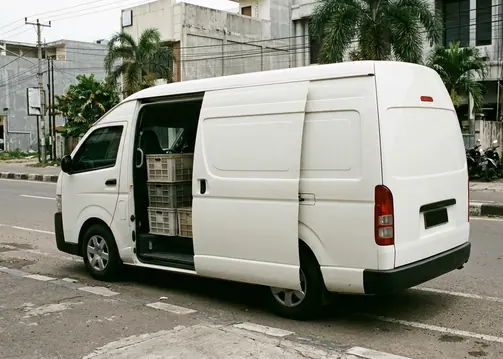
Anchor staples win the merchant and then strain the van. Cooking oil, rice, and sugar drive adoption and repeat orders, and they compress payload efficiency. Those bulk commodities max out a delivery van's weight capacity before blended basket gross margin covers stem-mileage fuel and driver labor. The truck is heavy while the contribution line is still short. Higher-margin specialty bundles subsidize that transport overhead when they travel with the staple the kiosk already reorders. A specialty push that dies with the discount leaves the weight problem in place.
Minimum order rules pull the same lever from the basket side. They stop a drop from consuming a stop slot while contributing almost no gross profit. Rules set against staple weight and specialty attach give the route a margin mix it can carry.
Dividing a Fixed Route Block
Worked example. Hold fuel, lease share, and driver wages fixed for one shift, including stem mileage out and back. Eight completed stops leave a large route-cost share on each basket. Staple weight has already capped the payload, so those eight drops stay capped. Eighteen stops along one contiguous arterial cut inter-stop transit time and fuel burn. The same route-cost block then divides across more completed drops per driver shift. Lower-margin baskets move from net-negative to contribution-positive because stop frequency changed the denominator. The dispatch calculation is that division, checked against loaded gross profit before departure.
District Gates Before a Node Opens
Expansion underwriting at district level follows cohort net contribution. Before a micro-fulfillment node opens or a field team is hired, the audit covers local retail density, sub-distributor pricing power, and stem distance from the nearest mother warehouse. Three gates follow: minimum route density on the arterials the vans will run, a SKU margin mix able to carry staple weight, and merchant payback that closes on unsubsidized orders.
City gross merchandise value and route-level contribution diverge sharply. Multi-homing warungs chasing temporary trade discounts can lift city GMV while every arterial still fails its fuel and labor test. Unsubsidized net contribution, read on the individual arterial route, shows whether the van cleared direct cost after the promotion ended. Growth capital placed on the rising GMV line, while discounting and half-empty runs conceal negative unit contribution, funds the burn.
Manifest Clearance Test
A district dispatch manifest clears for departure only when consolidated gross margin on the loaded orders exceeds that route's direct fuel, driver labor, and handling threshold. Partially loaded trucks wait for the next confirming cluster on the same corridor.
Dawn at the district node. The regional operations lead stands over the dispatch board, route cards open. A delivery truck sits at the dock, half-empty, staple cases short of the load the route needs. Fuel and labor for the stem are already priced on the card. Another string of warung orders along the same arterial is still confirming. The lead holds the truck. When consolidated order weight and gross margin clear the route's fuel and labor threshold, the board marks the run and the driver takes the key. Until that mark, the truck stays.